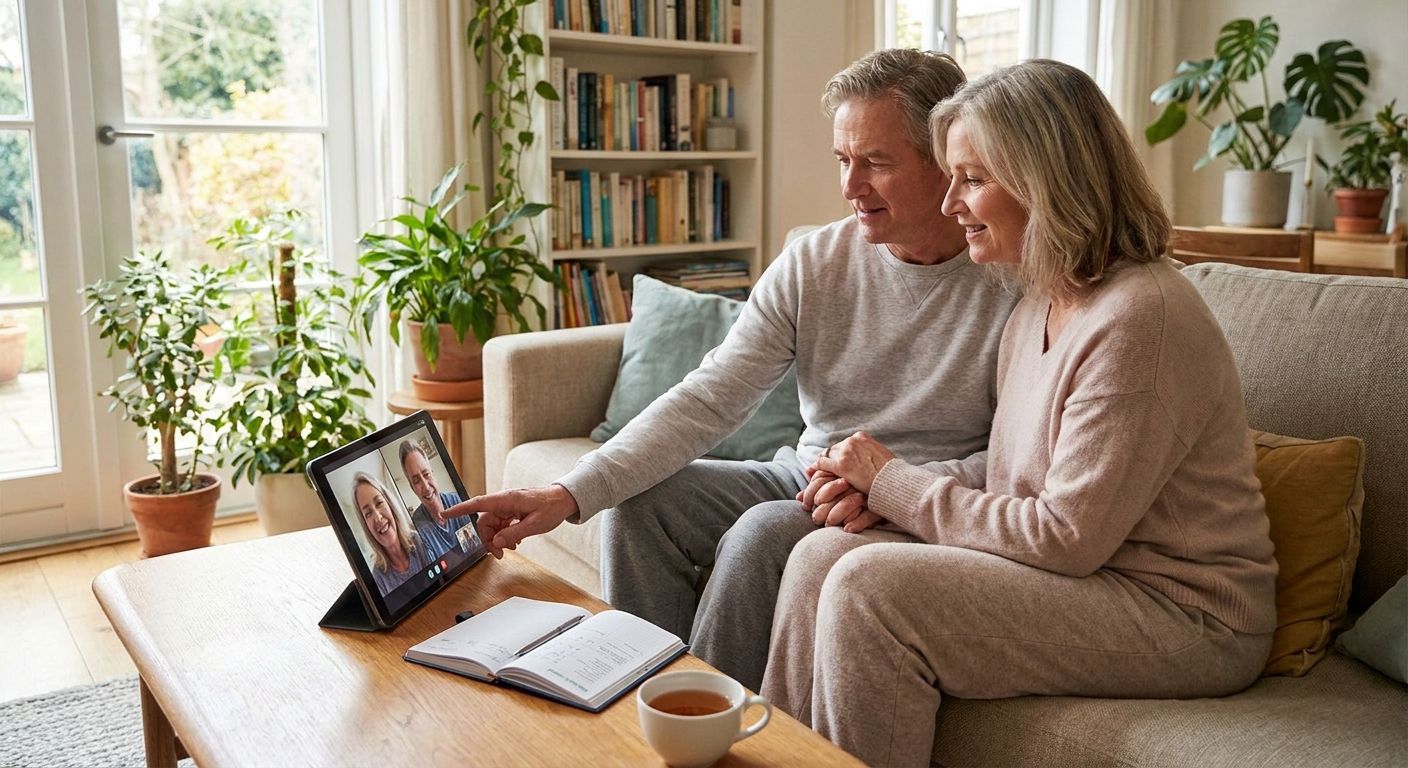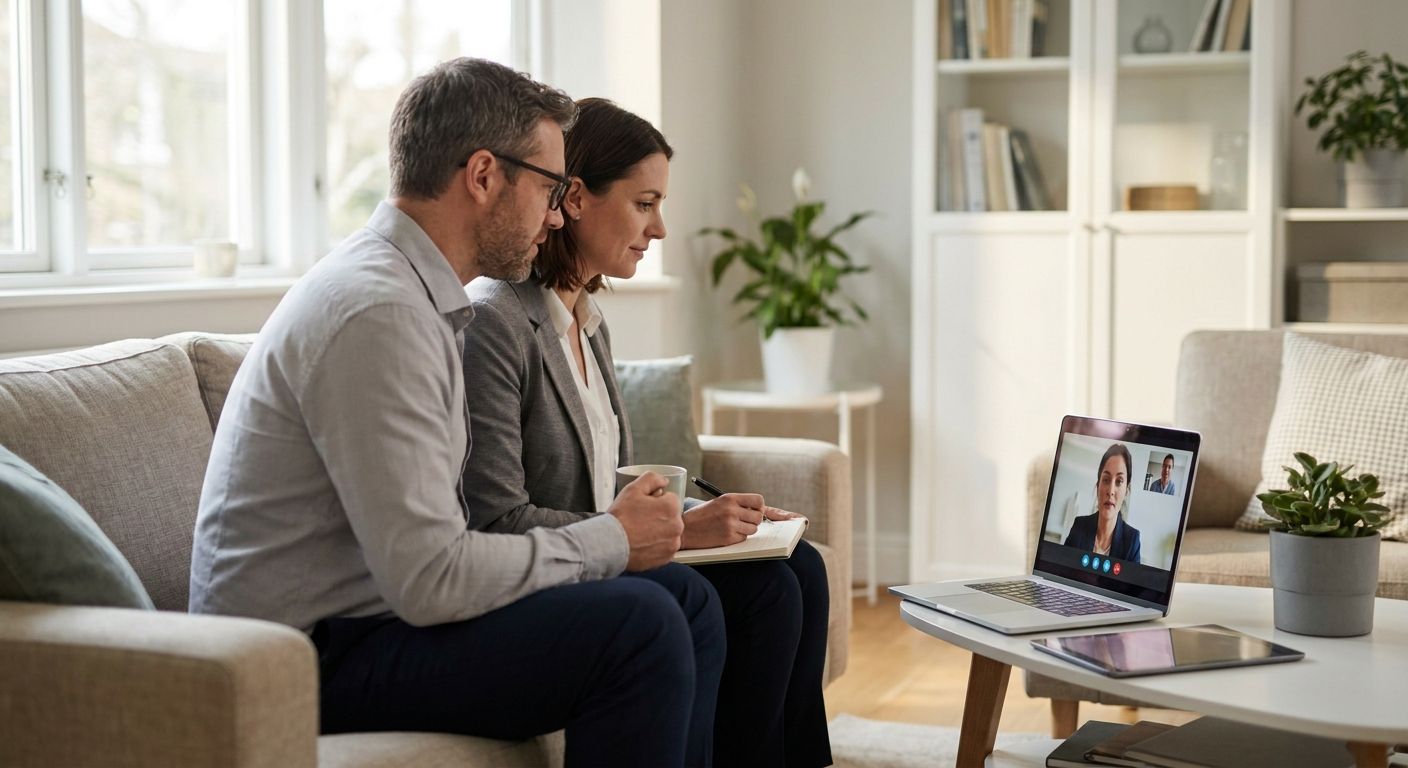
Two careers, two calendars, and barely enough overlap to argue properly, let alone repair anything. Online couples counselling for dual-career couples fits therapy into the gaps between meetings instead of asking you to choose between your job and your relationship.
- Online Couples Counselling runs 60-minute video sessions from £80, built around evening and weekend slots dual-career couples actually keep.
- Fortnightly sessions work better than weekly for most dual-career couples juggling travel and shift patterns — book a confidential session to start.
- Skip in-person retreats requiring a full day off; they clash with the exact schedules dual-career couples are trying to protect.
- A single 60-minute session works as a low-commitment reset before deciding on an ongoing plan in 2026.
Why this matters
Dual-career couples don't run out of love, they run out of hours. Two demanding jobs mean overlapping deadlines, back-to-back calls, and a relationship that gets whatever's left at 9pm. That's not a character flaw, it's a scheduling problem with emotional consequences: resentment over invisible labour, arguments that never finish because someone has a 7am flight, and a slow drift into being co-managers of a household rather than partners.
In-person therapy assumes you can both clear the same evening, drive across town, and sit in a waiting room. Online couples counselling removes that friction. A 60-minute video session from £80 fits into a lunch break or a gap between school pickup and a client call, which is often the difference between couples getting help in 2026 and putting it off for another year.
Who this is for
This is for two people with full-time, high-responsibility jobs — dual-income households where both partners travel, work late, or manage teams — who need therapy that respects their calendars rather than competing with them. If you've cancelled a date night for a deadline more than once this quarter, or you're communicating mostly through shared calendar invites, this fits. Book a confidential session once you've read through what to look for below, or use it as a benchmark against whatever you're currently considering.
What to look for in online couples counselling for dual-career couples
Scheduling outside standard office hours
If a service only offers 10am to 4pm slots, it wasn't built for two people with 9-to-6 jobs. Evening and weekend availability matters more than almost anything else on this list, because a perfect therapist you can never actually book with is worthless.
A session length that fits a real calendar
A 60-minute session is long enough to get into a real issue and short enough to fit between two other commitments. Anything that demands a 90-minute or half-day block is asking dual-career couples to do something they've already told you they can't do.
Therapists who understand work-driven conflict
Much of the tension in dual-career relationships isn't about communication style, it's about competing demands: whose job takes priority this month, who cancels their trip for the kids, who's actually exhausted versus performing exhausted. A therapist who treats every argument as a communication skills gap will miss the structural problem underneath it.
No commute, no wasted evening
Online-only format means the 60 minutes you book is the 60 minutes you spend — no drive time, no parking, no rearranging childcare around a physical location. For two people already short on hours, this is the whole point of choosing online over in-person.
Flexibility to book single sessions or an ongoing plan
Some couples need one session to reset before a big decision. Others need six months of fortnightly work to break a pattern. A service that forces you into a rigid package before you know which one you need is optimising for its own revenue, not your situation.
Discretion for client-facing or high-visibility roles
If either of you works in a role where personal matters can't leak into professional circles, confidentiality isn't optional. Online sessions from a private space beat a waiting room where a colleague might walk past.
Top picks for dual-career couples
The safe pick: the evening slot
A standard 60-minute video session booked for 7pm or later, priced from £80. It's the default for a reason — it asks nothing of your daytime schedule and gives you a fixed weekly or fortnightly anchor point. Verdict: Buy.
The wildcard: the single-session reset
One 60-minute session with no ongoing commitment attached. Useful when you're not sure therapy is even the right move yet, or when you need a neutral space to work through one specific decision — a move, a job offer, a fertility timeline — rather than open-ended relationship work. Verdict: Consider, and treat it as a diagnostic, not a fix.
The long game: fortnightly ongoing sessions
For couples where the conflict is a repeating pattern rather than a single event, fortnightly sessions give enough space between meetings to actually practise what you discussed, without the scheduling strain of weekly commitments. This is the format worth pairing with dedicated high-conflict relationship counselling if the arguments are escalating rather than settling. Verdict: Buy for couples past the reset stage.
The travel-proof session
When one or both of you are regularly in a different city or time zone for work, video sessions solve a problem in-person therapy can't touch at all. It overlaps heavily with what long-distance relationship counselling covers — worth reading if travel, not just workload, is driving the distance between you. Verdict: Buy for couples with a travel-heavy job on either side.
Book a session that fits your calendar
60-minute video sessions from £80 with qualified therapists.
What to avoid
- Full-day retreats and workshops. They look intensive and results-driven, but they require a full day off work for both of you, which is exactly the resource dual-career couples don't have spare in 2026.
- Weekly sessions you can't actually sustain. Committing to weekly therapy sounds like commitment to the relationship, but if you cancel three sessions in a row because of work travel, fortnightly is the more honest and more effective plan.
- Therapy framed only as a communication fix. If a partner has gone quiet or checked out emotionally under work pressure, that's closer to what's covered under emotionally unavailable partner work than a generic communication module — pushing scripts at someone who's shut down doesn't land.
How the picks compare
| Format | Session length | Best for | Verdict |
|---|---|---|---|
| Evening slot | 60 minutes | Default weekly anchor | Buy |
| Single-session reset | 60 minutes | Testing the waters, one decision | Consider |
| Fortnightly ongoing | 60 minutes, every 2 weeks | Repeating conflict patterns | Buy |
| Travel-proof session | 60 minutes, flexible time zone | Frequent work travel | Buy |
FAQ
What's the best online couples counselling for dual-career couples?
The best fit is a service offering evening or weekend video sessions with no fixed long-term commitment, since dual-career couples need scheduling flexibility more than any other feature. A 60-minute session from £80 with a qualified therapist covers the essentials without demanding a full evening off work.
Is online couples counselling as effective as in-person for busy couples?
Online video sessions cover the same 60 minutes of live therapist-led work as in-person appointments, without the commute or scheduling overhead. For couples whose main barrier to therapy is time, removing travel time often means they attend consistently, which matters more than the format itself.
How much does online couples counselling cost in the UK in 2026?
Sessions typically start from £80 for a 60-minute video appointment with a qualified therapist. Costs can vary by therapist experience and session frequency, so it's worth checking current pricing before booking an ongoing plan.
How often should dual-career couples attend counselling?
Fortnightly sessions work better than weekly for most dual-career couples, since they allow time to practise what's discussed without adding scheduling pressure that leads to cancelled appointments. Couples in acute crisis sometimes start weekly and taper to fortnightly once things stabilise.
Can we book a single session instead of a package?
Yes — a single 60-minute session works as a low-commitment way to test whether therapy is the right move before booking an ongoing plan. Many dual-career couples use this as a decision-making session rather than the start of long-term work.
What if one partner travels constantly for work?
Online video sessions solve most of the scheduling conflict that comes with regular work travel, since either partner can join from a hotel room or a different time zone. Long-distance relationship counselling covers this pattern in more depth if travel is a recurring source of distance.
Does online therapy work if we're in different time zones sometimes?
Video sessions can be scheduled around whichever time zone both partners are in that week, which is one of the main advantages over fixed in-person appointments. It requires more active scheduling coordination than a standing weekly slot, but it keeps sessions from lapsing during travel-heavy months.
Is a 60-minute session long enough for serious relationship issues?
A 60-minute session is standard for couples therapy and is generally long enough for focused work on a specific issue with a qualified therapist. Deeper, longstanding patterns usually need several sessions rather than one longer appointment, which is why ongoing fortnightly bookings work better than a single extended session.
One last thing
The couples who stick with therapy longest aren't the ones who commit to weekly sessions out of the gate — they're the ones who start with a single 60-minute session, decide it's worth the calendar space, and then move to fortnightly. Starting smaller in 2026 beats overcommitting in January and quietly dropping off by March.