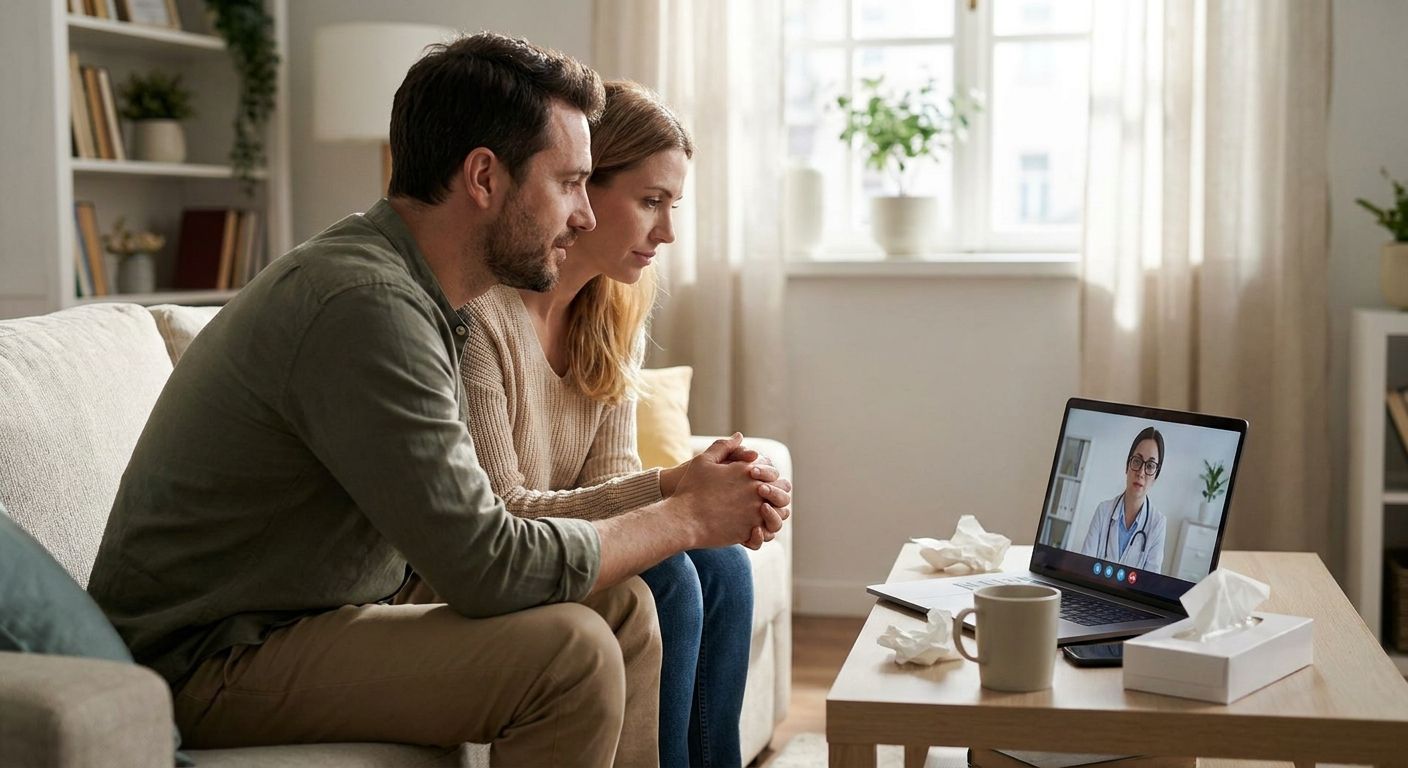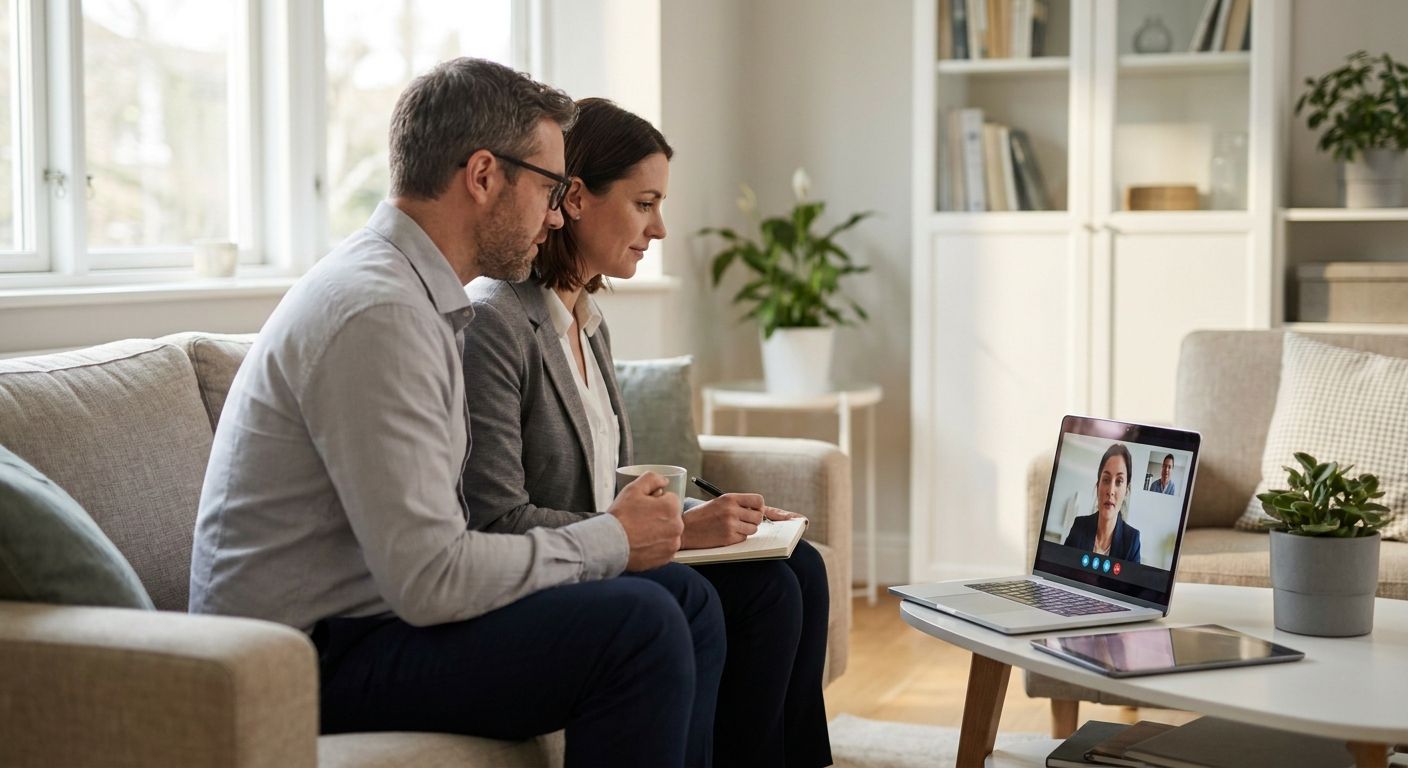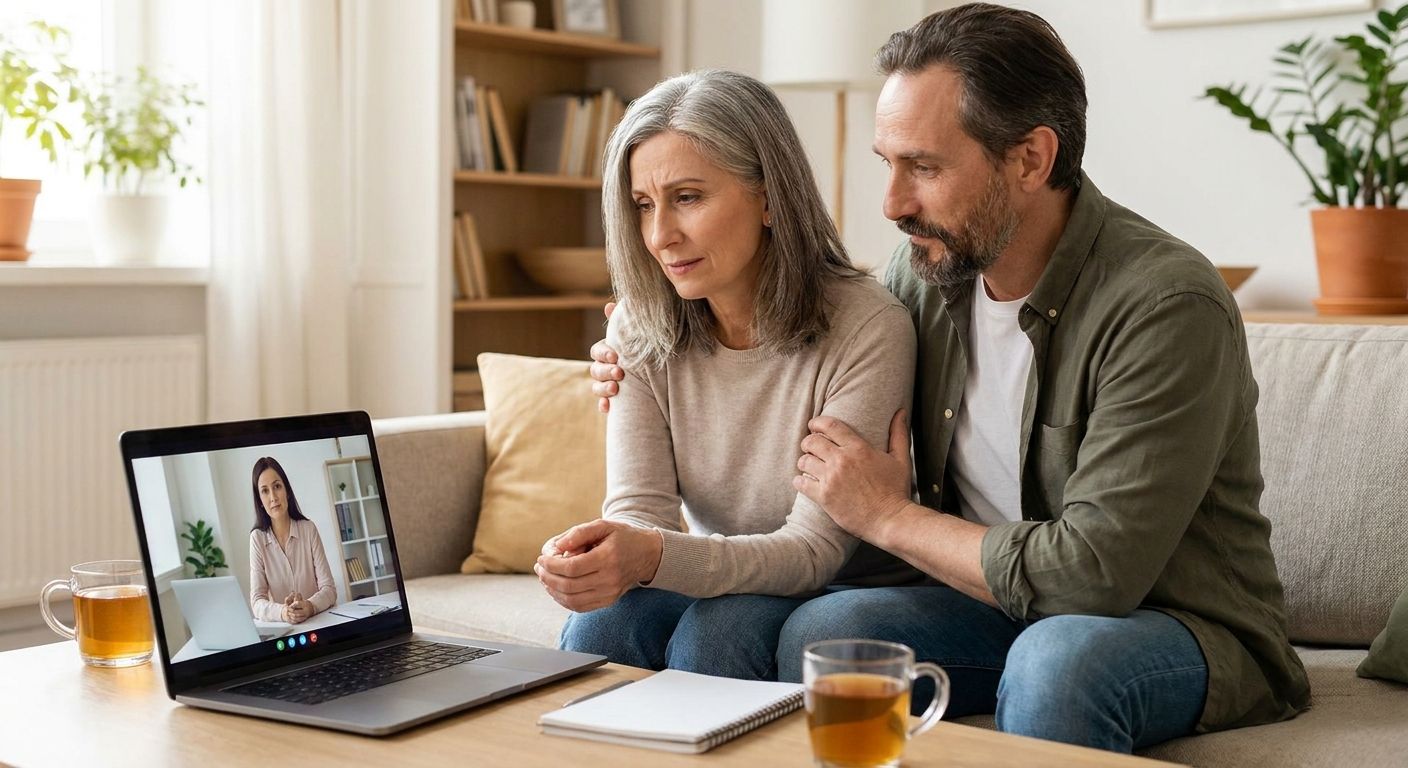
Long-distance relationships add a layer of friction that most therapy models weren't built for: time zones, patchy signal, and the ache of not being in the same room when things get hard. Online couples counselling for long-distance relationships solves the logistics problem without diluting the therapy itself.
- Standard 60-minute joint video sessions from £80 work for most long-distance couples on similar schedules - Buy.
- Fortnightly rhythm sessions suit couples with unpredictable rosters like shift workers or frequent flyers - Consider.
- Text-only or app-based check-ins without a qualified therapist are a Skip for long distance couples counselling.
- A three-hour-plus time zone gap needs a therapist willing to rotate the slot - confirm this before booking.
Why this matters
Distance doesn't cause relationship problems on its own, but it removes the small repair moments - a hand on the arm, a look across the kitchen - that couples in the same postcode rely on without noticing. When conflict happens over a screen and a six-hour time difference, small misunderstandings calcify into resentment faster.
Online couples counselling removes the geography excuse. A therapist licensed in the UK can run a confidential 60-minute video session with one partner in Manchester and the other in Singapore, provided the time slot works for both. The format matters less than whether the structure actually fits how the relationship is currently operating.
Who this is for
This guide is for couples where at least one partner lives outside commuting distance of the other - different cities, different countries, or different postings for work. It's for the couple juggling a nine-hour time gap for a job assignment, the pair separated by a visa process, and the long-term partners who see each other one weekend a month. If you can get in the same room for weekly in-person sessions, a local therapist may serve you better than remote work. If distance is the fixed constraint, Online Couples Counselling is built around exactly that gap.
What to look for in counselling for long-distance couples
Flexible scheduling across time zones
A long-distance couple rarely has identical daytime hours. Look for a therapist or service that offers slots outside standard 9-to-5 UK hours, since a session that only works for the partner physically in Britain isn't couples counselling - it's individual counselling with an audience.
A single therapist, not a rotating roster
Continuity matters more for distance couples because there's less shared context to rebuild each session. A therapist who remembers last week's argument about missed calls saves you from re-explaining the relationship from scratch every fortnight.
Video, not text or voice-only
Tone and facial expression carry information that text strips out entirely. A qualified therapist watching both faces on a 60-minute video call catches the wince or the pause that a chat transcript never will.
Confidentiality that holds across two locations
Both partners need reassurance that the session isn't recorded or shared, particularly when one partner is on a work visa or living with family who might overhear. Ask directly how session confidentiality is handled before the first booking.
Session length that allows for lag
Video calls across distance carry more technical friction - dropped connections, audio delay, one partner joining from a phone in a car park. A 60-minute session gives enough buffer to lose five minutes to a reconnect and still do real work.
Clear, upfront pricing
Distance couples often split costs awkwardly across currencies or bank accounts. A flat rate, such as £80 per session, removes an argument before it starts.
Top picks for long-distance couples
Standard 60-minute joint video session - the default option. Both partners join the same live call with a qualified therapist, priced from £80 in 2026. This works when both partners can find one overlapping hour a week, even if it's 8am for one and 4pm for the other. Buy if your schedules overlap at all - it's the format most therapists are trained to run, and it keeps both voices in the room at once.
Fortnightly rhythm sessions - the wildcard for irregular schedules. Instead of a fixed weekly slot, sessions are booked every two weeks around shift patterns, deployments, or rotating rosters. The trade-off is slower momentum between sessions, so expect more homework between calls. Consider this if one partner works nights, offshore, or on a rotating contract where a fixed weekly hour simply doesn't exist.
Timezone-anchored booking - the safe pick for couples split by more than four hours. One partner's morning becomes the other's evening, and the session is locked to whichever slot both can reliably hit without sacrificing sleep. Buy if your gap is Europe-to-Asia or UK-to-US-West-Coast sized; guessing a slot week to week just causes missed sessions.
Individual check-ins alongside joint sessions - not a replacement, a supplement. Some couples add a short individual conversation with the same therapist between joint sessions, mainly to process something that surfaced but didn't get airtime in the shared call. Consider this only once the joint sessions are established - starting here instead of together defeats the purpose.
Free relationship apps with chat-based "counselling" - looks convenient, isn't therapy. No qualified therapist, no confidentiality standard, no accountability if the advice is wrong. Skip entirely for anything beyond light check-ins; it's not a substitute for a licensed session.
Book your first session
Confidential 60-minute video sessions with a qualified therapist, from £80.
What to avoid
- A therapist who won't shift outside 9-to-5 GMT. If every slot offered assumes both partners are awake in the UK at the same time, the service isn't built for distance couples.
- "Couples coaching" with no clinical qualification. Coaching can sound reassuring but doesn't carry the same accountability as counselling from a qualified therapist - check credentials before booking.
- Group forums or peer-support apps marketed as counselling. These can feel supportive but don't replace confidential, one-to-one work with a therapist trained in relationship dynamics.
“If you're renegotiating the session time every single week, the relationship's real problem right now is logistics, not communication.”
Verdict comparison
| Format | Best for | Session length | Verdict |
|---|---|---|---|
| Standard joint video session | Overlapping schedules | 60 minutes | Buy |
| Fortnightly rhythm sessions | Shift work, rotating rosters | 60 minutes | Consider |
| Timezone-anchored booking | 4+ hour time gaps | 60 minutes | Buy |
| Individual check-ins | Supplementing joint work | Shorter, ad hoc | Consider |
| App-based chat "counselling" | Nothing serious | N/A | Skip |
FAQ
Does online couples counselling work for long-distance relationships?
Yes, online couples counselling works for long-distance relationships as long as both partners can join the same live video session. A qualified therapist runs the same 60-minute format used for local couples, just adjusted for time zones.
How much does couples counselling for long distance relationships cost?
Sessions start from £80 for a 60-minute video session with a qualified therapist in 2026. Pricing is typically flat regardless of where each partner is located.
Is video counselling as effective as in-person for long-distance couples?
For couples who are already apart, video counselling is often more practical than in-person, since travelling to the same room defeats the point of remote sessions. The therapist still sees both faces and reactions live, which is what most of the clinical value depends on.
What if we're in completely different time zones?
Look for a therapist or service willing to rotate the session time so the inconvenience isn't always carried by one partner. A fixed slot that only works for one person's clock tends to create resentment over time.
Can one partner join by phone if the video connection drops?
Most 60-minute sessions build in enough time to reconnect if a call drops, since long-distance connections are more prone to lag. It's worth confirming with the therapist beforehand what happens if one partner loses signal mid-session.
How often should long-distance couples do counselling?
Weekly sessions give the fastest progress, but fortnightly works for couples with unpredictable schedules like shift work or travel-heavy jobs. Consistency matters more than frequency - skipping sessions for a month and restarting loses momentum.
Do we need to be UK residents to book?
The therapists are UK-qualified, and sessions are typically aimed at UK-based couples, though one partner being temporarily abroad doesn't rule out booking. Confirm directly with the service if one partner is based outside the UK long-term.
Is online counselling confidential when one partner isn't in a private space?
Confidentiality depends on both partners finding a private space to join from, which is harder when one partner is staying with family or in shared accommodation abroad. Raise this with the therapist before the first session so everyone knows what's expected.
One last thing
The couples who get the most out of remote counselling aren't the ones with the smallest time gap - they're the ones who treat the session time as fixed, not negotiable. Couples who let the slot slide week to week around whoever's more tired that day tend to drop off within a month; couples who protect the hour like a flight booking tend to stick with it long enough to see change.
If distance is the main strain right now, a confidential 60-minute session with a qualified therapist from £80 is a reasonable first step before deciding whether the relationship needs more than logistics fixed.